Teachlytics - AI-Powered Learning and Assessment Platform
AI / Machine Learning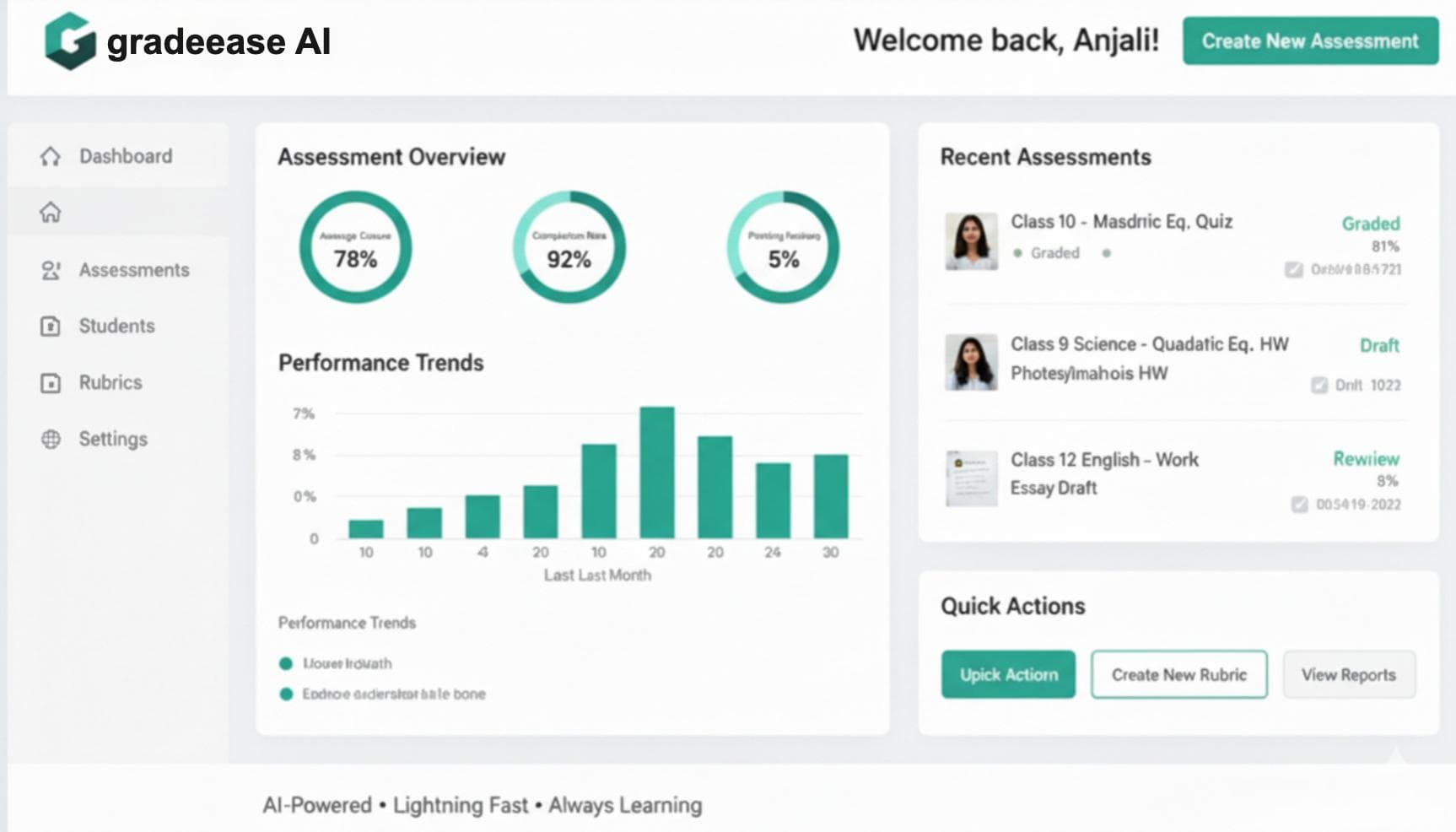
Project Overview
Teachlytics is an AI-powered learning and assessment platform built with Next.js and FastAPI. It combines asynchronous backend processing, cloud storage, authentication, and LLM-based workflows to support automated grading and plagiarism detection in educational assessments.
Tech Stack
The Problem
Manual assessment and grading can require substantial time and effort from educators. Evaluating submissions consistently and identifying potential plagiarism also present challenges when managing digital assessments at scale.
The Solution
Designed a full-stack platform combining a Next.js frontend with a FastAPI backend to support AI-assisted assessment workflows. The architecture incorporates asynchronous task processing, relational data management, cloud file storage, and authentication to support grading and plagiarism-detection functionality.
Key Features
- AI-assisted automated grading
- Plagiarism detection workflows
- Full-stack learning platform
- REST API backend with FastAPI
- Asynchronous task processing with Celery and Redis
- PostgreSQL data persistence
- Cloud file storage with AWS S3
- JWT-based authentication
- Google OAuth integration
- Database migrations with Alembic
Challenges
- Designing a full-stack architecture that integrates AI workflows with application services
- Managing asynchronous processing for computationally intensive assessment tasks
- Coordinating frontend and backend data flows
- Designing reliable database migrations and data persistence
- Integrating authentication and cloud storage into the application
Learnings
- Building full-stack applications with Next.js and FastAPI
- Designing asynchronous processing workflows using Celery and Redis
- Managing relational databases with SQLAlchemy and Alembic
- Integrating AWS S3 for cloud file storage
- Implementing JWT authentication and Google OAuth
- Designing backend architecture for AI-assisted educational applications
Case Study
Teachlytics — AI-Powered Learning and Assessment
Overview
Teachlytics is a full-stack educational technology project focused on AI-assisted assessment. It combines a modern web interface with a Python backend and supporting infrastructure for grading and plagiarism-detection workflows.
Problem
Manual grading can be time-consuming, while maintaining consistency across assessments and reviewing submissions for potential plagiarism requires additional effort. Digital assessment tools can help streamline these workflows through automation and structured submission management.
Solution
I designed the application around Next.js and FastAPI, with backend infrastructure to support AI-assisted assessment workflows, asynchronous task execution, database management, authentication, and file storage.
Technical Architecture
- Frontend: Next.js, React, and TypeScript.
- Backend: FastAPI and Python.
- Database: PostgreSQL with SQLAlchemy.
- Database migrations: Alembic.
- Background processing: Celery and Redis.
- File storage: AWS S3.
- Authentication: JWT and Google OAuth.
Core Capabilities
The project focuses on automated grading and plagiarism detection, supported by an architecture that separates frontend interactions, backend APIs, persistent data, and asynchronous processing.
Key Takeaways
Teachlytics brings together full-stack engineering and AI-assisted educational workflows. It demonstrates my experience designing Python APIs, building modern web applications, integrating cloud services, and structuring backend systems for asynchronous workloads.
Technologies
Next.js, React, TypeScript, FastAPI, Python, PostgreSQL, SQLAlchemy, Alembic, Celery, Redis, AWS S3, JWT, and Google OAuth.